
Know your ovarian reserve before you are ready to try, while there is still time to act on the answer.
Fertility check-up →Fertility Care in Los Angeles
Find out where you stand, in weeks.
A focused fertility evaluation with ovarian reserve testing, physician-performed ultrasound, tubal testing, ovulation treatment and IUI — all coordinated by one physician. Less waiting. Fewer handoffs. A clear plan for what comes next.
Most new patients are seen within a few days. See how the evaluation works.
Where to begin
Patients arrive here from four directions.
Planning ahead
Trying without success
A complete evaluation of both partners, sequenced properly, without months lost between referrals.
Fertility evaluation →
Irregular cycles or PCOS
Find out whether you are ovulating at all, and treat the underlying problem rather than working around it.
Ovulation & PCOS →
Not sure whether you need IVF
A clear evaluation, and an honest threshold for the point at which reproductive endocrinology makes sense.
What we do here →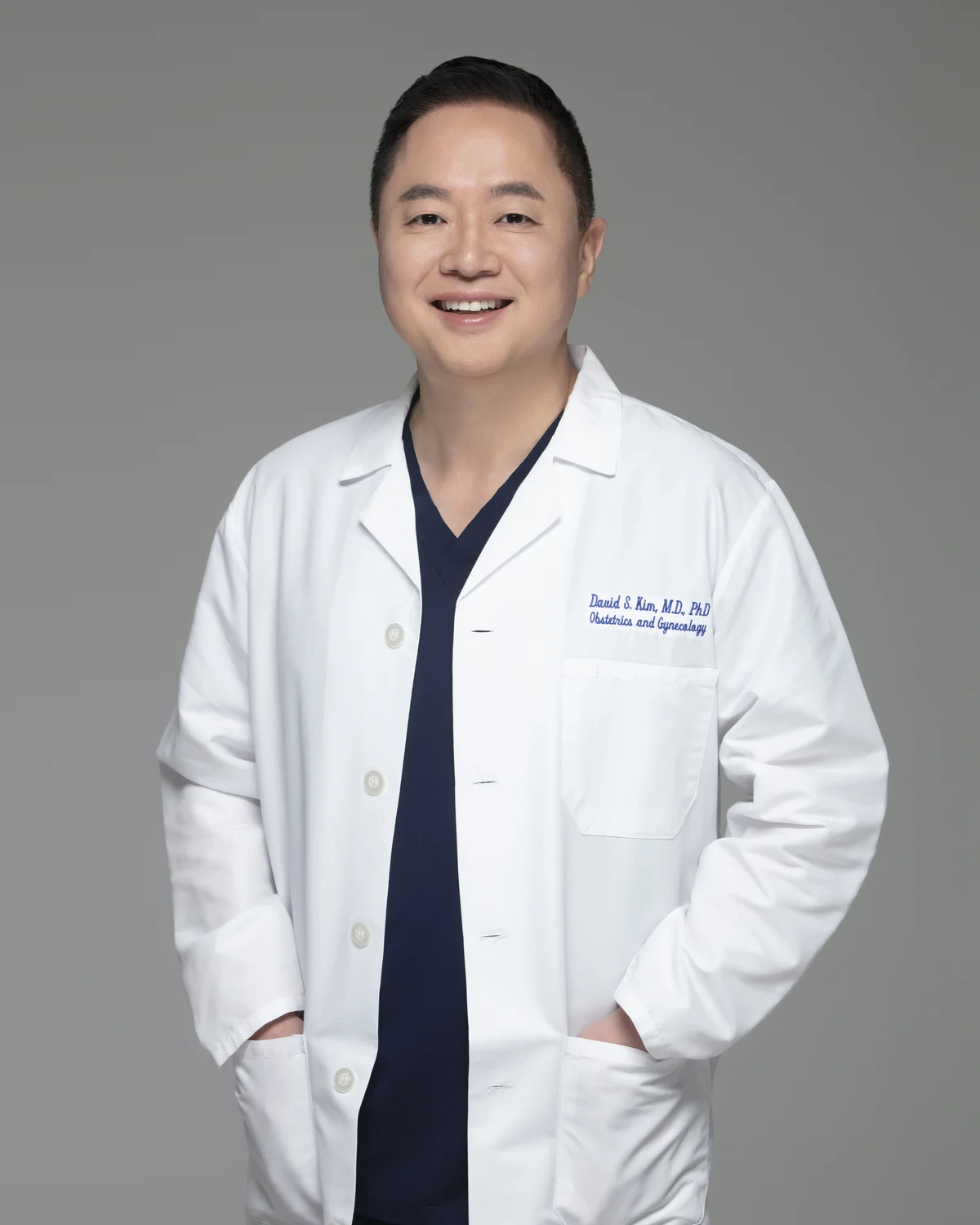
Your physician
The step between your OB/GYN and an IVF centre.
Not everyone trying to conceive needs IVF. For many patients the right first step is a careful evaluation, treatment of the problem that is actually present, and a clear threshold for when reproductive endocrinology makes sense. You do not have to start at an IVF centre because you have questions about fertility.
- ExperienceNearly 30 years in obstetrics & gynecology
- In-office imagingUltrasound and HyFoSy performed by Dr. Kim
- Cedars-Sinai Medical Center15 years · OB/GYN residency faculty
- American Board of Obstetrics & GynecologyOral board examiner
- Los Angeles Magazine Top Doctor2020–2024 · 2026
And if you conceive here, you do not start over with a new doctor.
Dr. Kim continues your care through the early ultrasounds, the pregnancy, and delivery at Cedars-Sinai. See pregnancy care or concierge maternity.
Why patients come to us
Where fertility care loses time.
Not the medicine. The distance between the offices that hold each piece of it.
-
01
Testing spread across separate places
Bloodwork at a lab, imaging at a radiology suite, results in a portal — and a wait to have them read together.
-
02
Only one partner evaluated
A male factor is involved in about half of couples. Testing one side first is how cycles quietly accumulate.
-
03
Treatment that repeats without a threshold
When no one says in advance how many attempts is enough, the decision to change course becomes one you have to raise yourself.
None of this is a failure of medicine. It is what happens when the pieces of an evaluation live in different places. It is simply not the only way this can be arranged.
The difference
The same six months, two ways.
The usual referral path
Often begins with a one to three month wait just to get the first OB/GYN appointment.
Month 1
Consultation; labs & ultrasound ordered
Month 2
Imaging centre for an HSG (tubal imaging with radiation exposure)
Month 3
Follow-up to review results; referral to a fertility specialist
Month 4
Waiting for the specialist’s new-patient opening; records sent, some tests repeated
Month 5
Follow-up visit to develop a plan
Month 6
First treatment cycle
Fertility care at Yunella
Visit 1 · Week 1
Consultation, labs & ultrasound with Dr. Kim
Visit 2 · Week 2
HyFoSy (non-radiation tubal imaging) — plan developed from imaging & lab results
Visit 3 · Week 2–3
Plan established — treatment cycle begins soon after
Nothing here is faster medicine. It is the same tests, ordered in the right order, by someone who reads them himself. The questions patients ask first are answered below.
Fertility services
Testing and treatment, in one practice.
Fertility care in Los Angeles is usually split between a gynecologist, an outside laboratory, an imaging centre and, eventually, a fertility clinic. Here is what is done under one roof at Yunella, and where the line is drawn.
Before you start trying
- A fertility check-up is a reasonable thing to do before there is a problem. Ovarian reserve, cycle pattern and a pelvic ultrasound give you a baseline while you still have time to act on it.
- Preconception fertility planning for patients weighing when to start, or how long they can reasonably wait.
- Particularly worth doing if your cycles are irregular, you have known PCOS or endometriosis, or there is a family history of early menopause.
The evaluation, done in weeks
- A full fertility evaluation for both partners, sequenced so that cycle-timed tests are not missed and repeated a month later.
- Ovarian reserve testing — AMH, day 2 to 4 FSH and estradiol, and an antral follicle count performed on the ultrasound by Dr. Kim rather than by a technician.
- HyFoSy tubal patency testing in the office. Foam contrast and ultrasound rather than X-ray and iodinated dye, without a trip to a radiology suite.
- Semen analysis arranged at the same time, not after the female workup is finished.
Treatment we provide here
- Ovulation induction with letrozole or clomiphene, monitored by ultrasound so the cycle is timed rather than guessed.
- Intrauterine insemination (IUI), with or without induction, depending on what the evaluation showed.
- Irregular ovulation and anovulation, including PCOS — the most common reason cycles do not produce an egg, and the most treatable.
- Fibroids, endometrial polyps and endometriosis are operated on by the same physician rather than referred out and lost track of between cycles.
A clear threshold for what comes next
- Yunella does not perform IVF, and that is deliberate. When IVF offers the better path, Dr. Kim tells you directly and helps transition your care to a reproductive endocrinologist rather than extending lower-yield treatment.
- If IVF becomes the better option, we tell you early. Plans are reassessed after an agreed number of monitored cycles, so the decision point is set before you begin rather than raised after a year.
- And if you conceive, the same physician cares for the pregnancy. Early scans, the first trimester, and delivery at Cedars-Sinai — see pregnancy care and concierge maternity.
Tell us where you are in the process.
Whether you are planning ahead, just starting, or have been trying for months, we will help you understand which evaluation makes sense first.
The office
Everything happens in this room.
The ultrasound, the follicle counts, the HyFoSy, and the conversation about what they mean.

Fertility treatment asks for a lot of early mornings. Monitored cycles mean scans on particular days, often at short notice, often before work. That is the part patients underestimate.
So this is a small practice on purpose. You are expected. You are not kept waiting. No one asks you to explain yourself twice, and the scan is read out loud while you are still in the room rather than posted to a portal that evening.
We built for the mornings, not the milestones.
How the evaluation works
What the first six weeks look like.
Not trying yet
A fertility check-up is a single visit: ultrasound, ovarian reserve, and an honest read on your timeline. Nothing further is decided.
Trying, without success
Twelve months under 35, or six months at 35 and over, is the usual threshold for a full evaluation — sooner if your cycles are irregular.
Cycle days 2–4Hormone panel and AMH
After mensesHyFoSy tubal patency test
Cycles 1–3Ovulation induction, with or without IUI
If you conceiveEarly scans, then pregnancy care
Week 1First visit, exam & ultrasound
Weeks 1–3Semen analysis for your partner
Weeks 4–6Results read together, plan agreed
Decision pointContinue, change, or move to IVF
- Week 1First visit, exam & ultrasound
- Cycle days 2–4Hormone panel and AMH
- Weeks 1–3Semen analysis for your partner
- After mensesHyFoSy tubal patency test
- Weeks 4–6Results read together, plan agreed
- Cycles 1–3Ovulation induction, with or without IUI
- Decision pointContinue, change, or move to IVF
- If you conceiveEarly scans, then pregnancy care
Where we are.
Yunella is on San Vicente Boulevard at the edge of the Miracle Mile, and sees patients from Beverly Hills, West Hollywood, Hancock Park, Larchmont, Brentwood, Century City, Culver City and Santa Monica. For monitored cycles — which mean several short, early visits in a narrow window — that proximity matters more than patients expect.
Questions
What patients ask first.
Why see an OB/GYN for fertility instead of going straight to an IVF centre?
Not everyone trying to conceive needs IVF. For many patients the right first step is a careful evaluation, treatment of the problem that is actually present, and a clear threshold for when reproductive endocrinology makes sense. Starting here means you find out what is happening before committing to the most intensive option.
When should I see a fertility doctor?
The usual threshold is twelve months of trying under 35, or six months at 35 and older. Come sooner if your cycles are irregular or absent, if you have known PCOS, endometriosis or fibroids, if you have had two or more miscarriages, or if you simply want a baseline before you start trying.
What happens at the first fertility appointment?
History for both partners, a pelvic exam, and a transvaginal ultrasound performed by Dr. Kim in the office, including an antral follicle count. You leave with the full testing plan and the cycle days each test has to happen on, rather than a list of referrals to chase.
What is ovarian reserve testing, and what does a low AMH mean?
Ovarian reserve testing combines an AMH blood level with an antral follicle count on ultrasound, usually alongside day 2 to 4 FSH and estradiol. AMH reflects the size of the remaining egg supply. It predicts how ovaries respond to stimulation better than it predicts whether you can conceive naturally, so a low result changes urgency and strategy rather than closing the door.
What is HyFoSy, and how is it different from an HSG?
HyFoSy — hysterosalpingo-foam sonography — checks whether the fallopian tubes are open, using ultrasound and a foam contrast. Unlike a conventional HSG it involves no X-ray and no iodinated contrast, and it is performed in the office by your own physician rather than at a radiology suite.
Does my partner need to be tested?
Yes, at the start. A male factor is involved in roughly half of couples, and a semen analysis is faster, cheaper and less invasive than most of the female workup. Evaluating one partner alone costs cycles.
What is the difference between ovulation induction and IUI?
Ovulation induction uses medication such as letrozole or clomiphene to produce a mature follicle, with ultrasound monitoring to time the cycle. Intrauterine insemination places prepared sperm directly into the uterus at that time. They are often used together, but ovulation induction alone is appropriate when the problem is anovulation and the semen analysis is normal.
Do you treat PCOS?
Yes. Polycystic ovary syndrome is the most common cause of irregular ovulation and anovulation, and it is managed here — diagnosis, metabolic evaluation, and ovulation induction when pregnancy is the goal.
Do you perform IVF?
No. Yunella performs evaluation, ovulation induction and IUI. When IVF offers the better path, Dr. Kim says so directly and helps transition your care to a reproductive endocrinologist rather than extending lower-yield treatment.
How long before we change the plan?
Most treatment plans are reassessed after about three monitored cycles. That threshold is agreed at the outset, so the decision point arrives as a plan rather than a conversation you have to start yourself.
If I conceive, who cares for the pregnancy?
Dr. Kim does. The physician who managed the treatment cycle performs the early ultrasounds and continues through delivery at Cedars-Sinai, so the first trimester is not a handoff to someone meeting you for the first time.
Start here
The first step is an answer, not a treatment.
One visit is enough to know what will be tested, on which days, and what each result would change.
Or call (424) 404-8832.