
Hormones & Metabolic Health
PCOS Care in Los Angeles
A diagnosis, not a shrug.
Polycystic ovary syndrome affects roughly one in eight women, and most wait years to be told what is wrong. At Yunella, David Seil Kim, MD, PhD works it up properly — hormones, metabolism, ovulation, and the long-term risks that come with it — in a medical office on San Vicente Boulevard.
In-office ultrasound and lab work. Insurance and self-pay options.
Why patients come to us
Why PCOS Is So Often Missed
Most women are told it is nothing.
PCOS is one of the most common hormonal conditions there is, and one of the most consistently missed. The symptoms arrive separately, years apart, and each one gets handled on its own by a different person.
-
01
The acne goes to a dermatologist
Treated as a skin problem. Nobody asks about your cycle.
-
02
The irregular periods get a birth control pill
Which does regulate the bleeding, and also hides the pattern that would have led to the diagnosis.
-
03
The weight gain becomes your fault
Advice to eat less and move more, offered without anyone checking whether insulin resistance is driving it.
-
04
The diagnosis arrives at a fertility clinic
Often years later, when you are already trying to conceive and the clock feels loud.
Each of those visits was reasonable on its own. Together they are how a decade goes by.
A note on the name
PCOS Is Now Called PMOS
The name changed in 2026, and for a good reason.
In May 2026, an international consensus published in The Lancet renamed polycystic ovary syndrome to polyendocrine metabolic ovarian syndrome, or PMOS. The process ran fourteen years and involved 56 professional and patient organizations, including the Endocrine Society.
The reason is straightforward. The old name pointed at cysts, and the condition does not actually involve an increase in abnormal ovarian cysts. That single misleading word sent attention to the ovaries and away from the hormonal and metabolic problems that cause most of the trouble — which is part of why diagnosis is so often delayed.
We still say PCOS here, because that is the word you came looking for. But the new name describes what we are actually treating, and it is the reason this page spends as much time on insulin as it does on ovaries.
How it is diagnosed
How PCOS Is Diagnosed
Two out of three. And ruling things out.
PCOS is diagnosed against defined international criteria, not by impression. Adults need two of the following three, once other causes have been excluded.
Criterion one
Signs of excess androgen
Either on examination — acne that persists past adolescence, hair growth in a male pattern, thinning at the scalp — or on blood work showing elevated androgen levels. One or the other is enough; you do not need both.
Criterion two
Irregular or absent ovulation
Cycles that are long, unpredictable, or missing. This is usually the symptom that brings people in, and it is the one most often silenced with a pill before anyone works out why it is happening.
Criterion three
Ovarian appearance on ultrasound — or AMH
An ultrasound showing the characteristic ovarian pattern. Since the 2023 guideline update, an anti-Müllerian hormone blood test can be used instead of ultrasound in adults, which matters if imaging is difficult or unwanted.
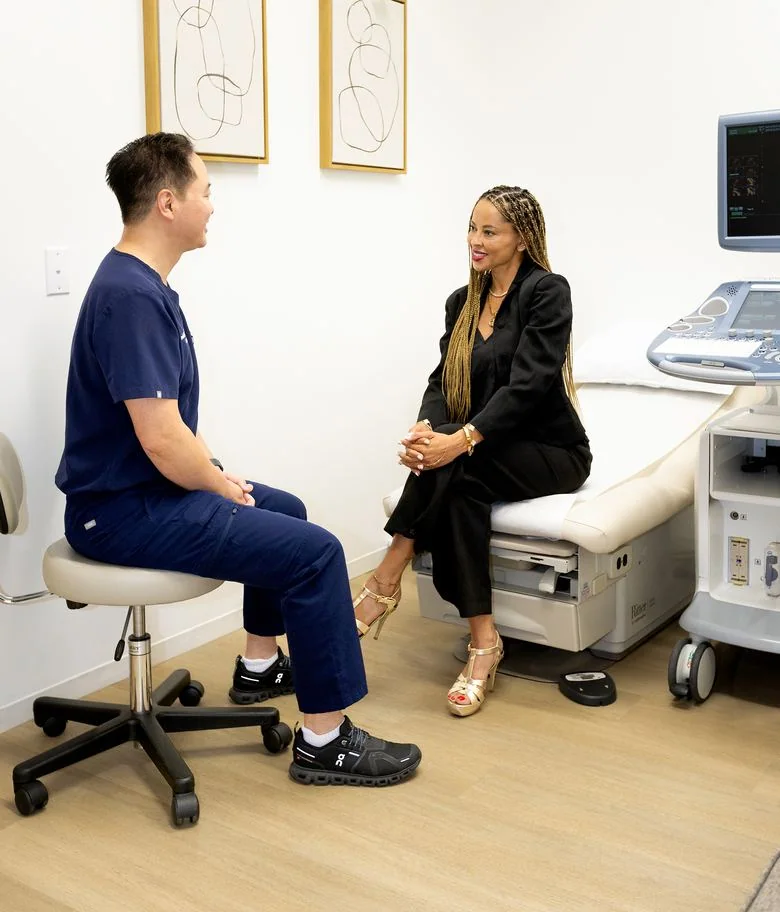
Dr. Kim performs the ultrasound himself, in the office, rather than sending you out for it.
And then
Excluding the conditions that imitate it
Thyroid disease, elevated prolactin, and non-classic congenital adrenal hyperplasia can all produce the same picture, and they are treated completely differently. Skipping this step is how people end up managed for years for something they do not have.
If you already have both irregular cycles and clear signs of excess androgen, the criteria are met and no imaging is required at all. We will tell you that rather than order a scan you do not need.
In adolescents the criteria are deliberately stricter, and neither ultrasound nor AMH is used, because normal puberty produces the same findings. Diagnosing a teenager too quickly is its own harm.
Bring whatever you have been tracking.
Cycle dates, old lab results, a list of what has changed. The first visit is a conversation and an examination, and you will leave knowing what is being tested and why.
What treatment involves
PCOS Treatment: Cycles, Metabolism, Skin and Fertility
Four problems, not one.
PCOS is not a single complaint to be quieted. It is a hormonal and metabolic condition with several fronts, and which one we work on first depends entirely on what you want from the next few years.
Cycles and the uterine lining
- Restoring a predictable bleeding pattern
- Protecting the endometrium, which matters because chronically absent periods raise the long-term risk of endometrial overgrowth
- Combined oral contraceptives remain the first-line treatment for irregular cycles and androgen symptoms
- Alternatives when estrogen is not appropriate for you
Insulin and metabolism
- Screening for insulin resistance, prediabetes and lipid changes rather than assuming them
- Metformin where the metabolic features warrant it
- GLP-1 medication where it is warranted, coordinated with our metabolic health program
- Blood pressure and cardiovascular risk, which the current guideline asks to be assessed in every patient
Skin and hair
- Acne and hair changes treated as endocrine problems, not cosmetic ones
- Anti-androgen therapy, prescribed here, when hormonal treatment alone has not been enough
- Honest timelines — hair responds slowly, and anyone promising fast results is guessing
- Referral for hair reduction when that is the better tool
Fertility, now or later
- Evaluation of whether and when you are ovulating
- Ovulation induction performed here, with letrozole, the current first-line medication
- Referral to reproductive endocrinology when treatment moves beyond what an OB-GYN office should handle
- Preconception planning, because PCOS raises risk in pregnancy and that is better managed before conception than during it
The order matters more than the list. Treatment aimed at conception looks different from treatment aimed at getting your skin and cycles under control for the next ten years, and the two are not interchangeable.
Ovulation induction, metabolic treatment and anti-androgen therapy are all handled in this office. Many practices send PCOS patients to three different specialists for those three things.
The part that gets skipped
Long-Term Health With PCOS
A lifelong condition that does not end at menopause.
Most PCOS care stops once the periods are regular or the baby arrives. That is the point at which the metabolic side quietly continues.
PCOS carries elevated long-term risk of type 2 diabetes and cardiovascular disease, and the 2023 international guideline strengthened its language on exactly this. It also formally recognized what patients have said for years — that sleep apnea and a very high burden of anxiety and depression travel with this diagnosis and deserve to be asked about rather than discovered.
So ongoing care here means periodic metabolic screening, blood pressure, a real conversation about mood, and endometrial protection maintained over years rather than months. It is unglamorous and it is the part that changes outcomes.
A diagnosis you received at twenty-four still applies at forty-four. Care continues through menopause.PCOS
The office
PCOS Care in Los Angeles
On San Vicente, at the edge of the Miracle Mile.
Where we are
Yunella Women's Health is at 6330 San Vicente Blvd, Suite 418, Los Angeles, CA 90048, on the fourth floor of the medical building at San Vicente and 6th.
Open Monday through Friday, 8:00 AM to 12:00 PM and 1:00 PM to 5:00 PM. Directions and parking →
Neighborhoods we serve
Yunella Women's Health is on San Vicente Boulevard in Los Angeles, seeing patients from Beverly Grove, Beverly Hills, West Hollywood, Miracle Mile and the surrounding West Los Angeles neighborhoods.
If you are looking for a PCOS doctor in Los Angeles, evaluation here can include hormonal testing, metabolic assessment and physician-performed pelvic ultrasound in one practice.
Where the testing happens
Ultrasound is performed in this office by Dr. Kim, not booked at an imaging center weeks out. Blood draws are done at the lab in the building next door, so it is a short walk rather than another appointment across town.
For a condition that takes several tests to confirm, and some of them timed to your cycle, that difference is most of what determines whether the workup actually gets finished.
Questions
PCOS FAQs
What patients ask before the first visit.
Do I have to have cysts to have PCOS?
No, and the name is the reason so many people think otherwise. What an ultrasound shows in PCOS is a particular pattern of small follicles, not the pathological cysts the word suggests. Research confirmed there is no increase in abnormal ovarian cysts in this condition, which is one of the reasons the name was changed in 2026.
Was PCOS renamed? What is PMOS?
Yes. In May 2026 an international consensus published in The Lancet renamed it polyendocrine metabolic ovarian syndrome, or PMOS. The change came out of a fourteen-year process involving 56 professional and patient organizations. The condition itself has not changed and neither has the treatment. We still use PCOS on this page because that is the term almost everyone searches for.
Can I be diagnosed without an ultrasound?
Often, yes. If you have both irregular cycles and clear signs of excess androgen, the criteria are already met and imaging adds nothing. And since the 2023 guideline update, an AMH blood test can be used in place of ultrasound in adults.
I have been on the pill for years. Can I still be evaluated?
Yes, though it changes the approach. Hormonal contraception suppresses the very findings we would be measuring, so parts of the workup are less informative while you are on it. We will discuss whether a washout period makes sense for you, and that is a decision to make together rather than a prerequisite we impose.
Does PCOS mean I cannot get pregnant?
No. PCOS is a common cause of difficulty conceiving because it disrupts ovulation, but many women with PCOS conceive without any treatment, and ovulation problems are among the more treatable causes of infertility. It does mean pregnancy carries some added risk, which is a reason to be evaluated before trying rather than after a year of trying.
Do I have to lose weight before you will treat me?
No. PCOS also occurs in women who are not overweight, and treating the condition is not conditional on your weight changing first. Where metabolic features are present we address them directly, as a medical problem, rather than handing you advice and sending you away.
Will birth control just mask the problem?
It is a fair concern, and the answer depends on why it is being prescribed. Given without a diagnosis, it hides the pattern. Given as treatment after a diagnosis, it is the first-line therapy for cycle irregularity and androgen symptoms, and it protects the uterine lining. The difference is whether anyone worked out what was happening first.
How long does the workup take?
Usually a first visit, blood work, and one follow-up. Some tests are timed to your cycle, so the calendar rather than the office is often what sets the pace. You will know the plan at the end of the first visit.
What should I bring to the first visit?
Whatever you have. Cycle dates or a tracking app, any previous lab results even if they are years old, a list of medications and supplements, and the history of what has changed and when. Old labs are genuinely useful here because PCOS is a pattern over time, not a single abnormal number.
Do I need a referral to be seen?
Not from us. Some insurance plans require one, particularly HMO plans, so it is worth checking with yours before you book. See the plans we accept.
Do I have to go somewhere else for the ultrasound and blood work?
The ultrasound is done here, in the office, by Dr. Kim on the day of your visit. Blood draws are done at the lab in the building next door, which is a short walk rather than a separate trip. Nothing in the workup requires you to cross town.
Do you take insurance for this?
Evaluation and management of PCOS is medical care and is billed the usual way. See the plans we accept, or the out-of-network page if we are not contracted with yours.
My teenager has irregular periods and acne. Should she be seen?
She should be evaluated, but you should also know that the criteria for adolescents are intentionally stricter, and that ultrasound and AMH are not used in that age group because normal puberty produces the same findings. Sometimes the right answer is to follow her over time rather than to attach a lifelong diagnosis at fifteen.
Medically reviewed
David Seil Kim, MD, PhD, FACOG
Board-certified obstetrician-gynecologist · Yunella Women’s Health, Los Angeles
Clinical references
- Teede HJ, et al. Polyendocrine metabolic ovarian syndrome, the new name for polycystic ovary syndrome: a multistep global consensus process. The Lancet, 2026.
- Recommendations from the 2023 International Evidence-based Guideline for the Assessment and Management of Polycystic Ovary Syndrome.
Next step
You are allowed to want an actual answer.
If you have been managing symptoms one at a time for years, a proper evaluation is a reasonable thing to ask for.