
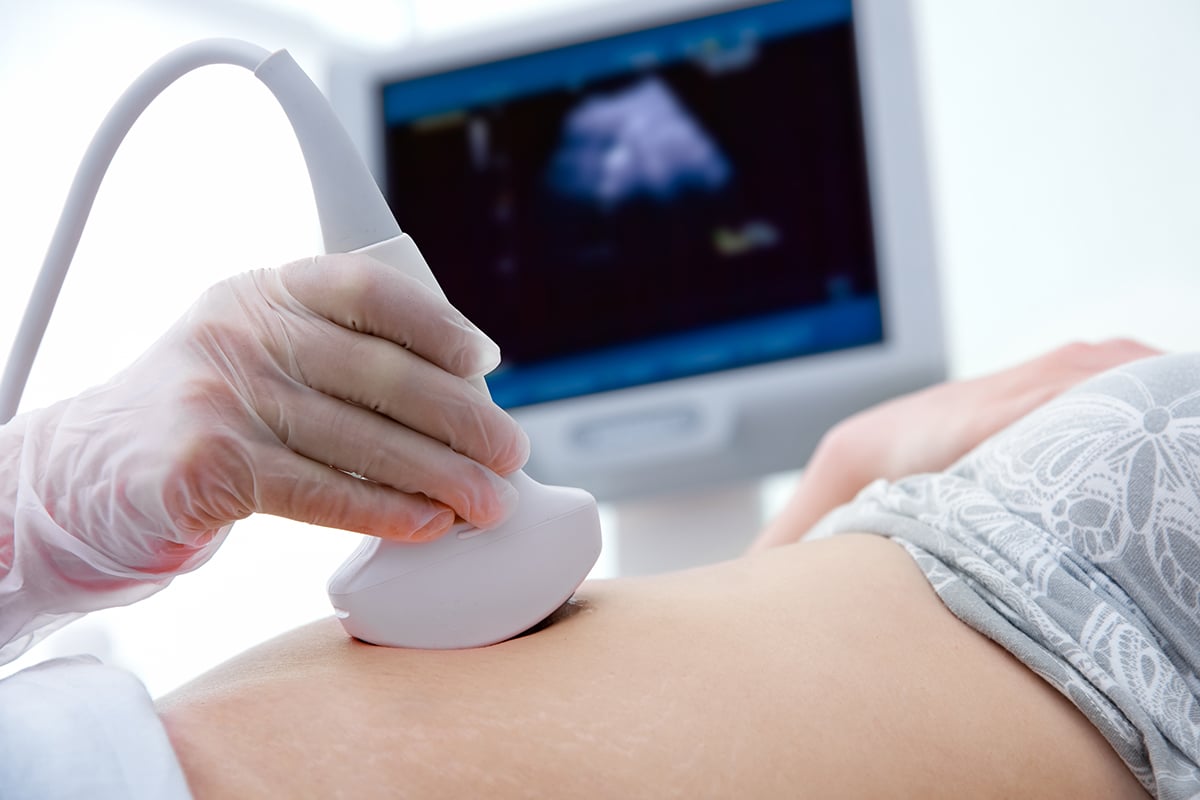
“How many ultrasounds will I get?” is one of the first questions patients ask after hearing the words “high-risk pregnancy.” It’s a reasonable question with an unsatisfying honest answer: it depends on why your pregnancy is high risk, and the number matters far less than the timing.
What follows is how the schedule is actually built, what each scan is looking for, and why more ultrasound isn’t automatically better care.
The baseline: what every pregnancy gets
A typical low-risk pregnancy includes an early ultrasound to confirm the pregnancy and establish the due date, an optional nuchal translucency scan between 11 and 14 weeks, and a detailed anatomy scan at roughly 18 to 22 weeks. Many uncomplicated pregnancies have no further scans after that unless something comes up.
That early dating scan matters more in a high-risk pregnancy than people realize. Almost every later decision about growth, testing, and delivery timing depends on knowing exactly how far along you are. A due date that is off by ten days can make a normally grown baby look small, or push a delivery plan past the window where it was meant to reduce risk.
Three different questions, three different schedules
“Ultrasound in a high-risk pregnancy” actually covers three separate jobs, and each runs on its own clock.
Anatomy and placenta. Is the baby structurally normal, and where and how is the placenta attached? This is mostly answered once, at the anatomy scan, with targeted follow-up when something needs a second look.
Growth. Is the baby growing along an expected curve? This is answered with serial measurements in the third trimester, spaced weeks apart.
Wellbeing. Is the baby doing well right now? This is answered with antenatal testing, such as a nonstress test or a biophysical profile, typically weekly or twice weekly late in pregnancy.
When a patient says they are having “an ultrasound every week,” it’s usually the third category: a biophysical profile uses ultrasound but is a wellbeing check, not a growth scan. Keeping the three separate is the easiest way to understand your own schedule.
Why growth scans aren’t done every week
This is the most common point of frustration, so it’s worth explaining.
Ultrasound estimates fetal weight from measurements of the head, abdomen, and thigh bone. Those estimates carry a real margin of error, commonly cited around 10 to 15 percent in either direction. If you measure a baby one week and again the next, the true change in size is smaller than the measurement error. The result can look like growth has stalled or jumped when nothing has happened at all.
That is why growth scans in a high-risk pregnancy are typically spaced about three to four weeks apart, and rarely closer than two. Scanning more often doesn’t give you more information. It gives you more noise, and noise leads to unnecessary worry and sometimes unnecessary early delivery.
When wellbeing testing starts, and why
Antenatal testing is meant to reduce the risk of stillbirth. ACOG suggests it for conditions where stillbirth occurs more often than 0.8 per 1,000, which is the false-negative rate of a biophysical profile, and where the condition at least doubles stillbirth risk compared with pregnancies without it.
For timing, ACOG’s suggestions generally fall into three starting points: at or by 32 weeks, at or by 36 weeks, or at or beyond 39 weeks if still undelivered. Starting at 32 weeks or later is appropriate for most at-risk patients, but with multiple or particularly worrisome conditions, such as chronic hypertension with suspected growth restriction, testing may begin at the point where delivery would be considered for the baby’s benefit.
Why 32 weeks and not earlier? Because the purpose of testing is to act on an abnormal result. Before the point where delivery would help the baby, an abnormal test often has nowhere useful to go.
Common high-risk schedules at a glance
These are typical patterns, not fixed rules. Your own schedule should be individualized.
| Situation | Growth scans | Wellbeing testing |
| Age 40+ at delivery | One third-trimester growth scan | Reasonable to start between 32 and 36 weeks |
| Age 35–39, no other risk factors | Not routinely required | Not routinely required |
| IVF pregnancy (singleton) | Third-trimester growth assessment; plus a 32-week placental check | Weekly, by 36 weeks |
| Chronic hypertension or pregestational diabetes | Serial third-trimester growth | Typically from 32 weeks |
| Diagnosed fetal growth restriction | Every few weeks, with Doppler studies more often | Individualized, often from diagnosis |
| Dichorionic twins | Every 4 weeks | Weekly may be considered from 36 weeks |
| Monochorionic twins | Every 2 weeks from 16 weeks | Typically from 32 weeks |
Twins: where the schedule changes the most
If there is one situation where ultrasound frequency genuinely jumps, it is twins who share a placenta.
That’s why determining chorionicity in the first trimester matters so much. For monochorionic-diamniotic twins, surveillance for twin-twin transfusion syndrome should begin at 16 weeks and continue at least every two weeks until delivery, with more frequent scans if there is concern. Those scans check amniotic fluid on both sides of the dividing membrane and whether each baby’s bladder is filling, and ideally include umbilical artery Doppler.
Twins with separate placentas are a different situation: in uncomplicated twin pregnancies, growth is assessed every four weeks.
When the schedule speeds up
Planned intervals change the moment the answer changes. Common triggers for scanning sooner or more often include:
- An estimated fetal weight or abdominal circumference below the 10th percentile
- Abnormal umbilical artery Doppler findings
- Too much or too little amniotic fluid
- New or worsening high blood pressure
- Decreased fetal movement
- Vaginal bleeding in the second or third trimester
Decreased fetal movement deserves its own line. It is the one indication patients control, and it should never wait for your next scheduled visit. Call.
What “more ultrasound” doesn’t buy you
Diagnostic ultrasound has an excellent safety record, so the case against extra scans isn’t about harm to the baby. It is about what the extra scan changes. A scan that can’t alter management produces results that can only reassure or alarm, and false alarms in late pregnancy lead to real interventions.
The better question to ask your OB isn’t “can I have more scans?” It’s “what is each scan on my schedule looking for, and what would we do differently depending on the result?” Every scan in a well-built high-risk plan has an answer to that question.
How this works at Yunella
Ultrasound at Yunella is performed in the office by Dr. Kim, so the physician managing your pregnancy is the one looking at the images and discussing findings with you at the same visit. When a situation needs specialized imaging, such as fetal echocardiography or maternal-fetal medicine co-management, it is arranged by referral and coordinated back into your plan.
Frequently asked questions
How many ultrasounds are normal in a high-risk pregnancy?
There is no single number. Most high-risk singleton pregnancies add a few growth scans in the third trimester plus weekly or twice-weekly wellbeing testing late in pregnancy.
Can too many ultrasounds hurt the baby?
Medical ultrasound has a strong safety record. The issue with extra scans is false alarms, not harm.
Why can’t I have a growth scan every week?
Because measurement error is larger than a week of real growth. Scans spaced a few weeks apart give a more accurate picture.
Is a biophysical profile the same as a growth scan?
No. A BPP checks current wellbeing; a growth scan checks size over time.
Do I need extra ultrasounds because I’m over 35?
Not routinely between 35 and 39. At 40 and older, a third-trimester growth scan is recommended. See Pregnancy after 35: what actually changes?
Does IVF change my ultrasound schedule?
Yes, in specific ways, including placental assessment and third-trimester growth. See Is an IVF pregnancy considered high risk?
This article is for education and does not replace individualized medical advice.
Medically Reviewed by David Seil Kim, MD, FACOG– September 17, 2026
Yunella Women’s Health provides personalized obstetric care for high-risk pregnancy in Los Angeles, including concierge maternity care with physician continuity from your first visit through delivery. Located on San Vicente Boulevard, serving Los Angeles and Beverly Hills. Call 424-404-8832.