
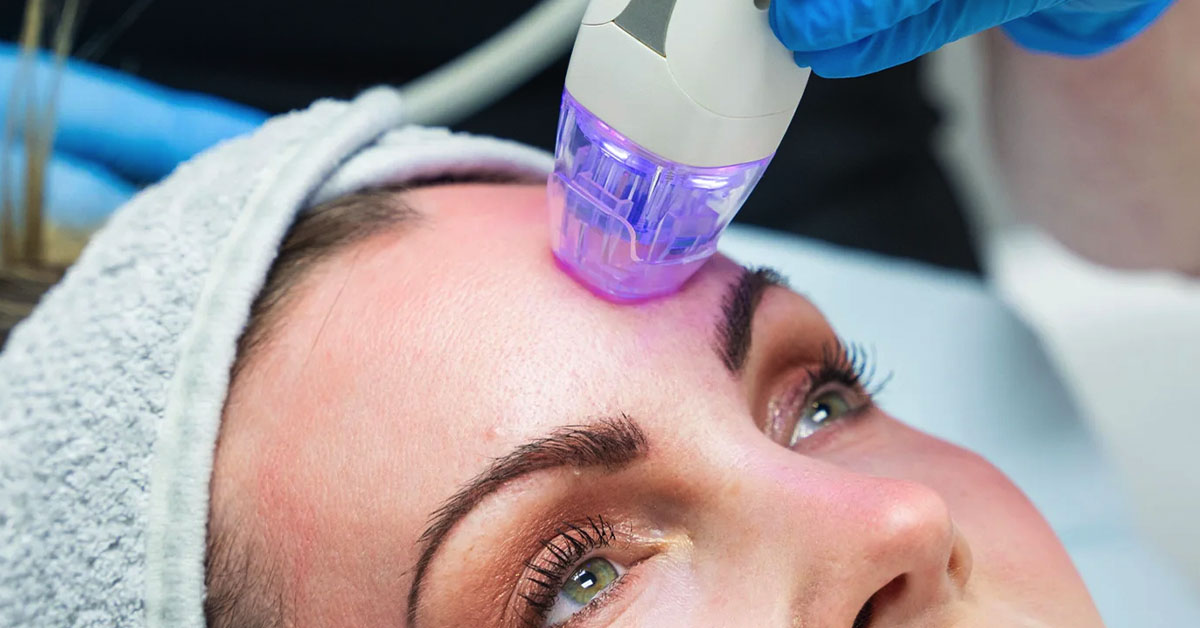
You’ve probably seen the photos. Someone posts a selfie with a bright red, slightly dotted face and a caption like “day one, worth it.” A few weeks later, their skin looks smoother and firmer than it has in years.
Or maybe you’ve heard the buzzwords. Microneedling. RF microneedling. The vampire facial. They’re all over social media, and they’re easy to mix up. Here’s the short version:
- Microneedling uses tiny needles to make small punctures in the skin, which pushes it to repair itself.
- The “vampire facial” is microneedling combined with PRP (platelet-rich plasma), a serum made from your own blood that is drawn on the day of treatment.
- RF microneedling adds radiofrequency energy, a gentle heat delivered through the needle tips beneath the surface. That heat is what lets it work on deeper concerns like acne scars, loose skin and stretch marks.
Potenza microneedling is a type of RF microneedling, done with the Potenza device. No blood draw is involved.
So does it actually work? How much does it hurt? Why is everyone’s face so red afterward, and how long does that last? And what could go wrong? This guide answers all of it honestly: what Potenza can and can’t do, what recovery is really like, and the risks worth knowing before you book.
What is Potenza RF microneedling?
Potenza combines two treatments in one.
Microneedling uses very fine needles to make tiny, controlled punctures in the skin. Your skin treats these as small injuries and responds by making new collagen, the protein that keeps skin firm and smooth.
Radiofrequency (RF) is a form of energy that creates gentle heat. Potenza sends that heat through the needle tips, so it reaches a set depth under the surface without burning the skin on top.
Together, the needles and the heat tighten the collagen you already have and push your skin to build more over the following months.
Potenza is FDA-cleared, and it was the first RF microneedling device with four energy modes. In plain terms, that means it can be set shallow for surface texture or deeper for scarring and tightening, and adjusted for different skin types and body areas.
What Potenza can (and can’t) do
On the face and neck, Potenza is used for:
- Fine lines
- Enlarged pores
- Uneven or rough texture
- Acne scarring
- Early loosening along the jawline
On the body, it’s used on the abdomen, arms, thighs and décolletage (upper chest) for crepey skin and stretch marks.
Just as important is what it won’t do:
- It isn’t a facelift. It can firm early laxity, but it won’t lift significant sagging.
- It doesn’t replace lost volume. Hollow cheeks or deep folds need a different approach.
- It won’t erase stretch marks. It can soften their texture and make the edges less obvious. Newer marks that are still pink or red usually respond better than older, silvery ones.
- It can’t fix separated stomach muscles. That’s a muscle issue, not a skin issue (more on this below).
If a treatment won’t fix what’s bothering you, we’ll tell you at your consultation.
What a session is like at Yunella
Every treatment starts with a consultation. We look at your skin, talk about what’s bothering you, and tell you what’s realistic. You get the cost before anything is scheduled.
On treatment day:
- Numbing cream goes on first and stays on for about 30 minutes.
- The treatment itself is done with the Potenza handpiece, pass by pass. Most people describe a warm, prickly feeling. One patient called it “just a little spicy” around the mouth and chin.
- An optional PDRN Rejuran ampoule can be added. It’s applied to the surface of your skin and absorbed through the tiny channels Potenza just made. It is not injected. It helps with hydration and comfort during recovery.
The whole visit takes about an hour. Every Potenza treatment at Yunella is performed by Dr. David Seil Kim himself. You’re treated by a physician, not a nurse or a technician, in our licensed medical office.
Results: what to expect, and when
Potenza works gradually, because collagen takes time to build. Here’s a realistic timeline.
The first day: Your skin will be red, a lot like a sunburn, and may feel warm or a bit swollen.
Days 2–5: Redness fades. Skin often feels rough, like fine sandpaper, and may flake slightly. Most people are comfortable wearing makeup by day two or three.
About 2 weeks: Skin often looks brighter and smoother. This is an early result, not the final one.
3–6 months: Collagen keeps rebuilding for months after your last session. This is when firmness, texture and scarring improve the most.
How many sessions? Most people need three, spaced four to six weeks apart. Acne scarring and body areas usually need more. Results vary from person to person, and we’ll give you a personal plan at your consultation.
The risks, honestly
Potenza is considered a low-downtime treatment, but it’s still a medical procedure, so it has risks.
Expected, and short-lived:
- Redness, warmth and mild swelling for a day or two
- Tiny pinpoint bleeding during treatment
- A rough, dry or flaky texture for a few days
- Small grid-like marks from the needle tip that usually fade within days
Less common:
- Breakouts in the days after treatment
- Cold sore flare-ups if you’re prone to them (tell us, because we may recommend medication beforehand)
- Post-inflammatory hyperpigmentation, or PIH. These are temporary dark patches that can appear after skin is irritated. They are more likely in deeper skin tones.
Rare:
- Burns, infection or scarring, usually linked to incorrect settings or poor aftercare
Is Potenza safe for darker skin tones?
RF microneedling is generally considered one of the safer options for deeper skin tones. Unlike many lasers, radiofrequency energy doesn’t target pigment. A 2023 systematic review in Dermatologic Surgery looked at 35 studies of RF and RF microneedling in skin of color. It found a low risk of scarring or pigment changes overall. Seven studies did report temporary hyperpigmentation, though.
Lower risk isn’t zero risk. Settings matter, and so does the experience of the person holding the device. That’s one reason Dr. Kim performs every Potenza treatment here himself.
Who should wait, or skip it
Potenza may not be right for you, or may need to wait, if you:
- Are pregnant. We don’t perform elective skin treatments during pregnancy.
- Have a pacemaker or another implanted electrical device. Radiofrequency energy can interfere with it.
- Have an active infection, cold sore, rash or acne flare in the area you want treated.
- Have recently taken isotretinoin (Accutane) or another medication that affects healing.
- Tend to form raised scars or keloids (thick scars that grow beyond the original wound).
- Take blood thinners or have a bleeding disorder.
If any of these apply to you, it doesn’t automatically rule you out. It’s a conversation to have at your consultation.
Potenza after pregnancy
Because Yunella is an OB-GYN practice, we get this question often. Here’s what we tell patients.
Timing matters. Skin on your stomach keeps tightening on its own for months after birth. If you treat it too early, you’re treating a moving target. Most people are cleared for elective skin treatment after their postpartum check, and many do better if they wait longer. We won’t schedule you before your body is ready.
Does Potenza microneedling work for stretch marks?
Yes, and we recommend it for postpartum stretch marks. Many of our patients choose Potenza after pregnancy to reduce the appearance of stretch marks on the stomach, hips and thighs. It remodels the collagen inside each mark, so the texture softens and the edges become less noticeable. Newer marks that are still pink or red usually respond best. Potenza can make stretch marks much less visible, but it won’t erase them completely, and anyone who promises that is overselling.
Because Dr. Kim is also an OB-GYN, he can see where you are in your recovery and tell you when the timing is right to start.
Separated stomach muscles aren’t a skin problem. Diastasis recti is a gap between the abdominal muscles. It’s treated with physical therapy, and sometimes surgery, not with an energy device. If that’s what’s going on, we’ll tell you and point you to the right care instead of selling you a series you don’t need.
If hormones, weight or pelvic health are also part of your recovery, those are handled on the medical side of our practice. See Medical Weight Management and our guide to GLP-1 medications.
Aftercare: how to protect your results
- First 24 hours: Keep your skin clean and use only the gentle products we give you. Skip makeup.
- First few days: Avoid retinol, acids, scrubs and other strong active skincare until your skin calms down.
- First 48 hours: Skip heavy workouts, saunas and hot yoga. Heat and sweat can irritate freshly treated skin.
- Every day: Wear sunscreen and avoid direct sun. This is the single best way to lower your risk of dark spots.
- Call us if you notice anything unexpected, such as blistering, worsening pain or signs of infection.
How to choose where to get Potenza
The device is only part of the result. The rest comes from who uses it and where. Before you book anywhere, ask:
- Is it done in a medical office with a physician on site? That matters most on the day something doesn’t go as planned.
- Who performs the treatment: a physician, a nurse or a technician? And will it be the same person each time?
- Is the device and tip genuine? It’s fair to ask to see the packaging. One of our patients did, and we were happy to show her.
- Will they tell you if Potenza isn’t right for you?
At Yunella Wellness & Aesthetics, every Potenza treatment is performed by Dr. Kim himself, inside our women’s health practice on San Vicente Boulevard. Read our patients’ Potenza reviews on Google and on our testimonials page.
Ready to talk about your skin?
A consultation is a conversation, not a commitment. We’ll look at your skin, tell you what Potenza can realistically do for you, and give you the cost before anything is scheduled.
Book a consultation or call (424) 404-8832. We’re at 6330 San Vicente Blvd, Suite 418, Los Angeles. See directions and location details.
Medically reviewed by David Seil Kim, MD, PhD, MBA, FACOG · Last reviewed: October 22nd, 2026