
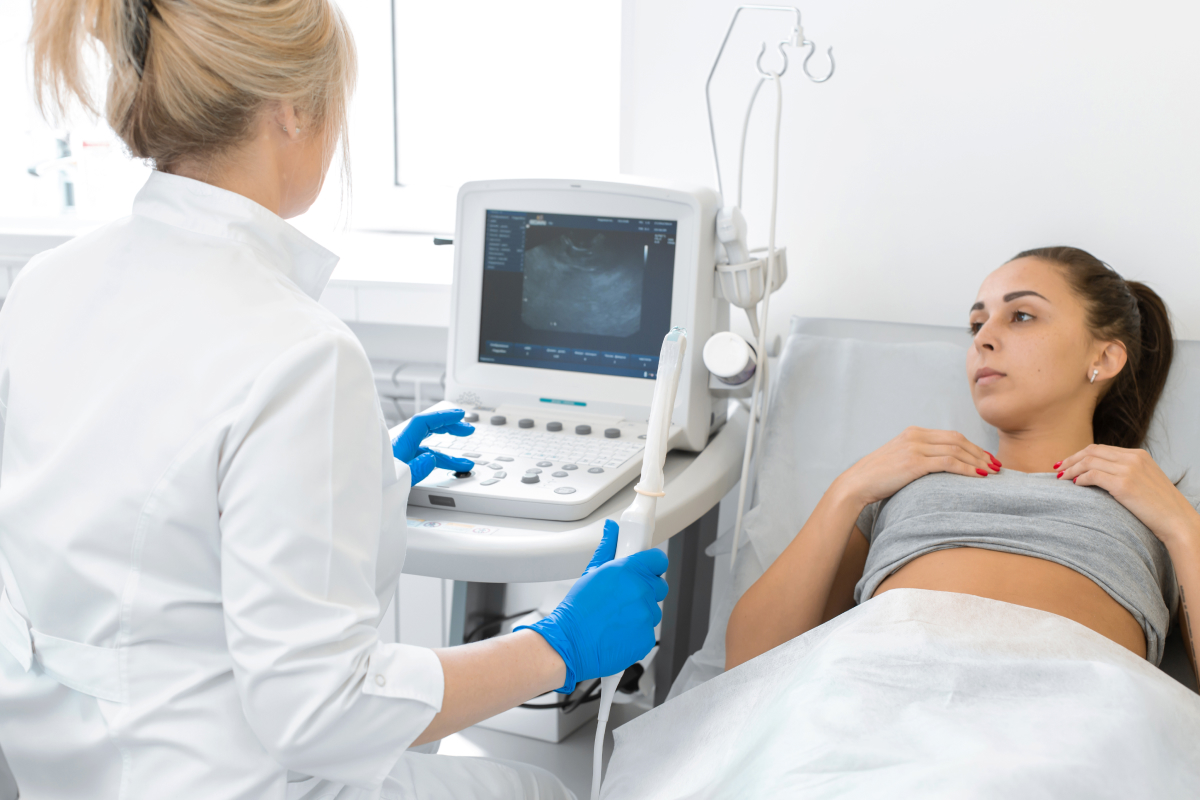
A saline sonogram, also called a saline ultrasound or saline infusion sonogram (SIS), is an ultrasound of the uterus done while a small amount of sterile salt water (saline) gently fills the inside of the uterus. The fluid opens up the cavity so your doctor can clearly see polyps, fibroids, scar tissue, or an unusually shaped uterus. It takes about 15 to 30 minutes and is done in the office.
Trying to conceive in Los Angeles? Dr. Kim does saline ultrasounds himself, in our office, and tells you what he sees the same day. Call (424) 404-8832 or request an appointment online.
Maybe your doctor saw something on a regular ultrasound that needs a closer look. Maybe you’re trying to get pregnant and it’s part of a fertility workup. Or maybe you’ve been dealing with heavy or irregular bleeding and want answers. Either way, you’ve been told you need a “saline ultrasound,” and you want to know what that actually means, and whether it’s going to hurt.
Here’s a step-by-step guide to what happens before, during and after, from Dr. David Seil Kim, who performs saline ultrasounds himself in our Los Angeles office.
What Is a Saline Sonogram?
A saline sonogram is a transvaginal ultrasound, the kind done with a slim wand placed in the vagina, with one added step: sterile saline is slowly placed inside the uterus during the scan.
Normally, the walls of the uterus rest against each other, a bit like a deflated balloon. On a regular ultrasound, that makes it hard to see small things growing from the lining. The saline gently separates the walls, so the inside of the uterus shows up as a clear, dark space with the lining outlined around it. Anything that doesn’t belong stands out.
Other names for a saline sonogram
You may hear it called any of these. They all mean the same test:
- Saline ultrasound
- Saline infusion sonogram (SIS), or saline infusion sonography
- Sonohysterogram or sonohysterography (SHG)
- Saline infusion sonohysterography
- Informally, a “saline exam,” “saline test for the uterus” or “water ultrasound”
What does a saline sonogram show?
According to the American Society for Reproductive Medicine, a saline sonogram can show:
- Uterine polyps: small, soft growths in the lining that can cause bleeding and get in the way of implantation
- Fibroids that bulge into the cavity (submucosal fibroids), the type most likely to affect fertility and pregnancy
- Scar tissue inside the uterus, sometimes after a D&C or surgery
- A differently shaped uterus, such as a septum (a wall of tissue dividing the cavity) that some women are born with
- A thickened lining that may need a closer look
Why would my doctor order a saline ultrasound?
Common reasons include:
- A regular ultrasound showed something unclear in the lining
- Heavy, irregular or prolonged periods, or bleeding between periods
- Bleeding after menopause
- Trouble getting pregnant, as part of a fertility evaluation
- Recurrent miscarriage, to check the shape of the uterus
- Before IVF or IUI, to make sure the cavity is ready for a pregnancy
In short, a regular ultrasound shows the outside of the uterus and the ovaries well. A saline sonogram is the best way to see the inside without surgery.
Saline Sonogram and Fertility: Why It Matters When You’re Trying to Conceive
A saline sonogram checks the place where a pregnancy has to implant and grow. If something inside the uterus is in the way, like a polyp, a fibroid in the cavity, scar tissue, or a septum, it can make it harder to get pregnant or stay pregnant. A saline sonogram is one of the most reliable ways to find these problems, and many of them can be fixed with a short procedure.
How the inside of the uterus affects getting pregnant
After an egg is fertilized, it travels to the uterus and has to attach, or implant, in the lining. Think of the lining as the soil a seed needs to take root. Anything growing from that surface, or changing its shape, can:
- Make it harder for an embryo to implant. Polyps and submucosal fibroids can act like a bump on the exact surface an embryo needs.
- Raise the chance of miscarriage. A septum or a fibroid pushing into the cavity has been linked to pregnancy loss.
- Cause bleeding that makes timing harder. Spotting between periods from a polyp can make it tricky to track your cycle.
The good news: these are some of the most treatable causes of trouble conceiving. According to the American Society for Reproductive Medicine, removing a submucosal fibroid with hysteroscopy fairly likely improves pregnancy rates. Studies of polyp removal in women with infertility have found similar benefits; our polyp article explains the evidence.
Why a regular ultrasound isn’t always enough
A standard transvaginal ultrasound is excellent for checking the ovaries, the outside of the uterus, and larger fibroids. But small polyps can blend into the lining and look like simple thickening. That’s how some women are told “everything looks normal” while a polyp is still there. Adding saline outlines the cavity so even small growths stand out. If you’ve been trying for a while and your first ultrasound was “normal,” a saline sonogram can be the test that finally finds the answer.
When a saline sonogram is part of a fertility workup
Dr. Kim may recommend one if:
- You’ve been trying to get pregnant for 12 months (or 6 months if you’re 35 or older) without success. See how long it usually takes to get pregnant.
- You’re about to start fertility treatment, like letrozole and IUI or IVF, and want to make sure the uterus is ready, so you don’t spend months of treatment on a cavity that has a problem
- You’ve had two or more miscarriages. A saline sonogram is part of a recurrent pregnancy loss evaluation, because it can show a septum or other shape differences.
- You have spotting between periods, or periods that are heavier or longer than they used to be
- A regular ultrasound showed a thick or uneven lining
It’s often paired with a fallopian tube test. The saline sonogram checks the uterus, and HyFoSy checks whether the tubes are open. Together with a hormone panel and a semen analysis, they cover the main things that have to go right for a pregnancy.
Can I try to get pregnant the same month as my saline sonogram?
Usually, yes. A saline sonogram is typically done after your period ends and before you ovulate, so it doesn’t interfere with that month’s chances. If the test finds a polyp or fibroid that needs to be removed, Dr. Kim will talk with you about timing. After a polyp is removed, he usually recommends waiting about two months before trying, to let the lining heal.
Does a saline sonogram improve fertility?
Not by itself. It’s a diagnostic test, not a treatment. Its value is in finding a problem that can be fixed, or in ruling one out so you and your doctor can focus elsewhere. And a normal result is good news: it means the inside of your uterus is ready for a pregnancy.
Been trying for a while? You don’t have to keep waiting for answers. A preconception visit can check your uterus, tubes and hormones in one place. Call (424) 404-8832.
Before Your Saline Sonogram: Timing and Preparation
There’s very little to prepare for a saline sonogram. The main things are choosing the right time in your cycle, making sure you’re not pregnant, and taking a pain reliever beforehand if you’d like.
When in my cycle should I have a saline ultrasound?
Many doctors prefer to do it in the days just after your period ends and before you ovulate. That’s usually somewhere in the first 10 days after your period starts, according to RadiologyInfo. At that point the lining is thin, which makes small polyps easier to spot, and there’s no chance of an early pregnancy.
That said, a saline sonogram can be done at other times when it’s needed. At Yunella, Dr. Kim can usually do it whenever it fits your schedule and your situation. If you’re postmenopausal, or on medication that stops your periods, timing doesn’t matter.
Do I need to do anything to prepare?
- Take a pain reliever about an hour before, if you’d like. Ibuprofen (Advil, Motrin) is commonly recommended to ease cramping, unless you’ve been told not to take it.
- Eat and drink normally. There’s no fasting.
- Tell us if you could be pregnant. A saline sonogram shouldn’t be done during pregnancy, so if there’s any chance, we’ll check first.
- Tell us if you have pelvic pain, fever or unusual discharge. The test is postponed if you might have an active pelvic infection.
- Light bleeding is usually OK, but call ahead if you’re bleeding heavily on the day of your appointment.
- Bring your partner or anyone you’d like. You’re welcome to have someone with you.
What Happens During a Saline Sonogram?
A saline sonogram feels a lot like a Pap smear followed by a regular vaginal ultrasound. The whole visit usually takes about 15 to 30 minutes, and the part with the saline is just a few minutes.
Step by step
- A regular ultrasound first. You’ll empty your bladder, lie back with your knees bent, and Dr. Kim will do a standard transvaginal ultrasound to look at your uterus and ovaries.
- A speculum. He places a speculum, the same tool used for a Pap smear, and cleans the cervix.
- A thin catheter. A very thin, soft tube is gently passed through the cervix into the uterus. This is usually the part you’ll feel most, often as a quick cramp.
- The speculum comes out. The catheter stays in place, and the ultrasound wand goes back in.
- The saline. A small amount of sterile saline is slowly placed into the uterus while Dr. Kim watches on the screen. This is when he gets the clearest view of the lining.
- Done. The catheter is removed. Most of the fluid comes back out on its own.
At Yunella, Dr. Kim talks you through what he’s seeing as he goes, and you can watch the screen if you want to. You don’t wait days for a report.
Does a saline sonogram hurt?
Most women describe it as uncomfortable rather than painful: cramping, similar to period cramps, while the catheter is placed and the saline goes in. The cramping usually eases within minutes after the test, though some women feel mild cramps for a few hours.
It may feel more uncomfortable if your cervix is tight (for example, if you’ve never had a vaginal birth) or if you tend to have painful periods. Taking ibuprofen ahead of time helps. Tell Dr. Kim if you’re uncomfortable at any point. He can slow down or pause.
How long does a saline sonogram take?
Usually about 15 to 30 minutes for the whole appointment, including the regular ultrasound and time to talk about the results. The saline part itself usually takes only about 5 minutes.
After Your Saline Sonogram
Most women go right back to their normal day after a saline sonogram. It’s normal to have some watery discharge, light spotting and mild cramping for a day or two.
What’s normal afterward
- Leaking fluid. Some of the saline drips out over the next few hours. Wearing a pad is a good idea.
- Light spotting for a day or two
- Mild cramping, usually gone within a few hours. Ibuprofen or acetaminophen helps.
You can go back to work, exercise and your normal routine right away.
When to call us
Serious problems are rare. Pelvic infection happens in fewer than 1 in 100 women, according to ASRM. Call us if, in the day or two after your test, you have:
- A fever
- Pelvic pain that’s getting worse instead of better
- Heavy bleeding
- Foul-smelling discharge
When will I get my results?
At Yunella, right away. Because Dr. Kim does the scan himself, he can tell you what he sees during the same visit: whether the cavity looks normal, and if not, what he found and what it means.
What happens if something is found?
It depends on what it is:
- A polyp can often be removed with a short procedure called a hysteroscopic polypectomy. Dr. Kim does these at PASC, our partner surgery center, often within about two weeks. Our polyp article walks through the steps.
- A fibroid inside the cavity may be removed the same way, with a hysteroscopic myomectomy. Not every fibroid needs treatment. Learn more about our fibroid care.
- Scar tissue or a uterine septum can often be treated with hysteroscopy as well.
- A thickened lining may need a small sample (biopsy) to make sure it’s healthy.
And if everything looks normal, that’s valuable information too. It rules out a common cause of bleeding or trouble conceiving, so you and Dr. Kim can focus on what’s next.
Saline Sonogram vs. HyFoSy, HSG and Hysteroscopy
These tests are related, but each one has a different job:
| Test | What it checks | How it’s done |
|---|---|---|
| Saline sonogram | The inside of the uterus: polyps, fibroids in the cavity, scar tissue, shape | Saline and ultrasound, in our office |
| HyFoSy | Whether the fallopian tubes are open | Foam and ultrasound, in our office, no X-ray |
| HSG | Whether the fallopian tubes are open | Dye and X-ray, at an imaging center |
| Hysteroscopy | A direct look inside the uterus, and treatment | A thin camera through the cervix, often used to remove what a saline sonogram finds |
A saline sonogram isn’t designed to check whether your tubes are open. In a fertility workup, a saline sonogram and a tube test are often done as a pair. Our article on HyFoSy vs. HSG explains the difference.
Saline Ultrasound at Yunella Women’s Health
At many practices, a saline sonogram means a referral to an imaging center, a technician you’ve never met, and a report that reaches your doctor days later. At Yunella, it’s different.
- Done by your doctor. Dr. Kim performs the saline ultrasound himself, in our office.
- Answers the same day. He explains what he sees as he goes, so you leave knowing your results.
- A private, familiar setting. No imaging center, and no hospital. Just our office and our team.
- One plan from start to finish. If a polyp or fibroid is found, the same doctor who found it can remove it.
- Part of a bigger picture. For women who are trying to conceive, a saline ultrasound often fits into a preconception or fertility visit along with a hormone panel and, if needed, a HyFoSy tube test.
Learn more about our in-office ultrasound and imaging.
Saline Sonogram: Frequently Asked Questions
What is a saline exam or saline test for the uterus?
It’s the same test as a saline sonogram: an ultrasound done while sterile salt water fills the uterus, so the doctor can see the lining clearly. “Saline exam” and “saline test” are informal names for it.
Is a saline sonogram the same as an HSG?
No. A saline sonogram uses saline and ultrasound to look inside the uterus. An HSG uses dye and X-ray to check whether the fallopian tubes are open. They’re often done as part of the same fertility workup, but they answer different questions.
Is a saline sonogram a fertility test?
It’s one part of a fertility evaluation. It checks the uterus, where an embryo has to implant. A full workup usually also includes a hormone panel, a tube test like HyFoSy, and a semen analysis.
Can a saline sonogram be done during my period?
It’s usually done just after your period ends, when the lining is thin and easiest to see. Light bleeding is usually OK, but call ahead if you’re bleeding heavily.
Can a saline sonogram detect endometriosis?
Not usually. Endometriosis mostly grows outside the uterus, and a saline sonogram looks at the inside. Learn more about how endometriosis is evaluated.
Can a saline sonogram detect cancer?
It can show a thickened lining or a growth that needs a closer look, but it can’t tell whether something is cancer. If something looks concerning, a small sample of the lining (biopsy) is the next step.
Can I drive home after a saline sonogram?
Yes. No sedation is needed, and most women go right back to their normal day.
Fertility Care With One Doctor, Start to Finish
- Preconception visit with an in-office ultrasound and full hormone panel
- Tube and uterus checks in our office: HyFoSy and saline ultrasound, done by Dr. Kim
- Letrozole and IUI in our office, with a personalized timeline
- Once you’re pregnant, Dr. Kim continues your prenatal care, with an ultrasound at every visit
Call (424) 404-8832 · Monday to Friday, 8 a.m. to 5 p.m.
After hours? Request an appointment online and we’ll call you back.
Learn more about fertility care at Yunella · Watch our patients’ stories
Medically reviewed by David Seil Kim, MD, PhD, MBA, FACOG · Last reviewed: November 19th, 2026