
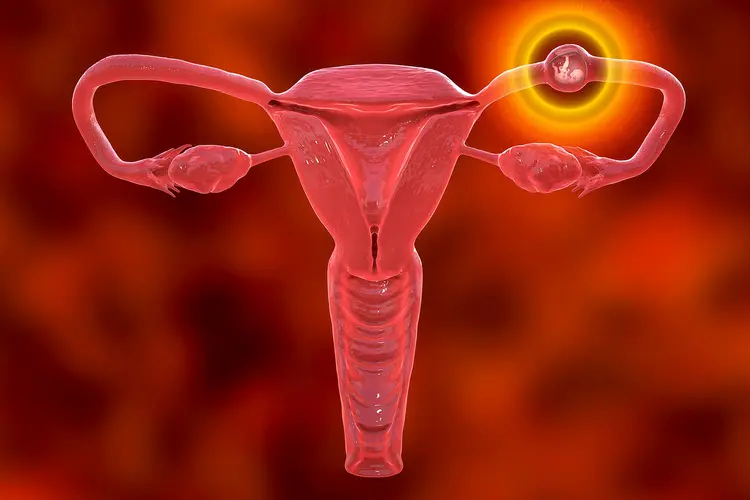
Ectopic pregnancy symptoms usually start between 4 and 12 weeks of pregnancy, most often around 6 to 8 weeks after your last period. Early signs include light spotting and cramping or pain on one side of your lower belly. Sudden, severe pain, shoulder tip pain, dizziness or fainting can mean the pregnancy has ruptured. If you have any of these, go to the emergency room right away.
Pregnant and worried about pain or spotting? Dr. Kim can usually see you the same day or within two to three days, with an hCG blood test and an ultrasound in the office. Call (424) 404-8832 or request an appointment online.
You have a positive test. Then something feels off. Maybe there’s spotting, a sharp pain on one side, or a cramp that doesn’t feel like your period.
Most of the time, early pregnancy spotting and cramping turn out to be normal. But one condition is worth knowing about, because early on it looks almost exactly like a normal pregnancy, and time matters. That condition is an ectopic pregnancy.
This guide explains what it is, when symptoms start, what it feels like, and how Dr. David Seil Kim checks for it.
What Is an Ectopic Pregnancy?
Normally, a fertilized egg travels down a fallopian tube and attaches to the lining of the uterus (the womb). The fallopian tubes are the two thin tubes that connect the ovaries to the uterus.
In an ectopic pregnancy, the egg attaches somewhere else, almost always inside a fallopian tube. According to Cleveland Clinic, about 9 in 10 ectopic pregnancies are in a tube, and ectopic pregnancy happens in roughly 2% of pregnancies.
A tube isn’t built to stretch the way the uterus does. As the pregnancy grows, the tube can burst, which is called a rupture, and cause serious internal bleeding. That is why an ectopic pregnancy is treated as a medical emergency. It is also why it can never continue as a normal pregnancy, even when everything else feels fine.
Early Signs of Ectopic Pregnancy
Early on, an ectopic pregnancy can feel exactly like a normal one: a missed period, a positive test, sore breasts, nausea. The difference usually shows up between about 5 and 10 weeks.
Call your doctor the same day if you’re pregnant and have:
- Spotting or light bleeding, especially with pain
- Cramping or pain that’s mostly on one side of your lower belly or pelvis
- Lower back pain that’s new or one-sided
- A pregnancy test that stays positive while your bleeding looks like a period
Go to the emergency room right away if you have:
- Sudden, sharp, severe pain in your belly or pelvis
- Pain in the tip of your shoulder, which can mean internal bleeding irritating a nerve
- Dizziness, weakness or fainting
- Rectal pressure, or feeling like you need to have a bowel movement that won’t come
- Heavy bleeding
Shoulder pain surprises people, because it doesn’t seem related to pregnancy. It’s one of the most important warning signs on this list.
When Does Ectopic Pregnancy Pain Start?
Ectopic pregnancy pain usually starts between 6 and 8 weeks after the first day of your last period, though it can begin as early as 4 weeks or as late as 12. It often starts as mild cramping or a dull ache on one side, then gets stronger as the pregnancy grows in a space that can’t stretch.
Some women have no pain at all until the tube ruptures. That’s why early checking matters if you have risk factors, even when you feel fine.
Signs of ectopic pregnancy at 4 weeks
At 4 weeks, most women with an ectopic pregnancy have no symptoms yet, or only light spotting and mild cramping that feel just like a normal early pregnancy. You may have only just gotten a positive test.
At this point, an ultrasound is usually too early to show where the pregnancy is. Instead, Dr. Kim checks your hCG level with a blood test and repeats it two days later. In a healthy pregnancy, hCG usually rises quickly. A slow rise, or a level that plateaus, can be an early clue.
Signs of ectopic pregnancy at 5 to 6 weeks
This is when symptoms most often start:
- Spotting or light bleeding, often brown or watery
- Cramping or a sharp, stabbing pain on one side
- Pain that comes and goes, and slowly gets worse
- Lower back pain, usually on the same side
By around 5 to 6 weeks, a transvaginal ultrasound can usually show a pregnancy inside the uterus. If your hCG is high enough that it should be visible and it isn’t, Dr. Kim will look closely for an ectopic pregnancy. Here’s what you’ll see at a 6-week ultrasound.
Signs of ectopic pregnancy at 7 to 8 weeks
If it hasn’t been found yet, this is when the risk of rupture is highest. Watch for:
- Sudden, severe pain in your lower belly or pelvis
- Shoulder tip pain
- Dizziness, weakness or fainting
- Feeling like you need to have a bowel movement that won’t come
These are emergency signs. Go to the ER or call 911.
What Does an Ectopic Pregnancy Feel Like?
Most women describe early ectopic pain as cramping or a sharp, stabbing pain low on one side of the belly, a little like period cramps or gas pain that won’t go away. It can be mild at first. Many women say it just felt “off,” or different from what they expected in early pregnancy.
As it progresses, the pain can become:
- Sharper and more constant
- Worse when you move, cough or have a bowel movement
- Spread across your whole lower belly
Where is ectopic pregnancy pain felt?
Usually low on one side of the pelvis, on the side of the affected fallopian tube. It can also show up in your lower back, your rectum (as pressure), or the tip of your shoulder. After a rupture, pain often spreads across the whole belly.
Does ectopic pregnancy pain come and go?
Yes, especially early on. Ectopic pain can come in waves and then ease for hours or even a day, which makes it easy to dismiss. Pain that comes and goes but keeps coming back on one side still needs to be checked. Don’t wait for it to become constant.
What does shoulder tip pain feel like?
Shoulder tip pain is an aching or sharp pain right where your shoulder ends and your arm begins, usually without any shoulder injury. It’s often worse when you lie down. It happens when blood from a ruptured or leaking ectopic pregnancy irritates the diaphragm, which shares nerves with the shoulder.
Shoulder tip pain in early pregnancy, especially with belly pain or dizziness, is an emergency. Go to the ER.
Normal Early Pregnancy vs. Ectopic Pregnancy Symptoms
Many symptoms overlap, which is why you can’t tell the two apart at home. These differences are worth knowing:
| Symptom | Normal early pregnancy | Possible ectopic pregnancy |
|---|---|---|
| Cramping | Mild, on both sides or in the middle, comes and goes | One-sided, sharp or stabbing, getting worse |
| Spotting | Light, pink or brown, stops within a day or two | Ongoing, brown or watery, often with pain |
| Pregnancy test | Positive, line gets darker | Positive, but hCG rises slowly or levels off on blood tests |
| Shoulder pain | Not a pregnancy symptom | Shoulder tip pain can mean internal bleeding |
| Dizziness | Mild lightheadedness can happen | Fainting or feeling faint with pain is an emergency |
| Ultrasound | Pregnancy seen inside the uterus by about 5 to 6 weeks | No pregnancy in the uterus once hCG is high enough to see one |
Does your belly grow with an ectopic pregnancy?
Not the way it does in a normal pregnancy. The uterus may soften and enlarge slightly from pregnancy hormones, but it doesn’t grow with the pregnancy. Early bloating is common in both normal and ectopic pregnancies, so belly size can’t tell you which one you have. A belly that suddenly becomes swollen, firm and painful can be a sign of internal bleeding and needs emergency care.
Who Is More Likely to Have an Ectopic Pregnancy?
Anything that damages or slows down the fallopian tube raises the risk. That includes:
- A previous ectopic pregnancy
- Past pelvic infections, including chlamydia or gonorrhea that went untreated. This is one reason we take vaginal infection testing seriously.
- Surgery on the tubes, including having your tubes tied
- Endometriosis
- Fertility treatment, including IVF
- Smoking
- Being 35 or older
- Getting pregnant with an IUD in place
About IUDs: an IUD is very good at preventing pregnancy. If a pregnancy does happen with one in place, though, it is more likely to be ectopic. If you have an IUD and get a positive test, call your doctor right away.
Here’s the part many people don’t expect. According to Cleveland Clinic, up to half of people who have an ectopic pregnancy have none of these risk factors. So the warning signs matter for everyone, not just people on this list.
Ectopic Pregnancy or Chemical Pregnancy?
In the first few weeks, both can look the same: a positive test, then bleeding. That’s why we wrote a separate guide on chemical pregnancy, a very early miscarriage that usually resolves on its own.
The difference shows up in two places:
- The hCG trend. hCG is the pregnancy hormone. After a chemical pregnancy it falls steadily. With an ectopic pregnancy it often rises slowly, levels off, or drops unevenly.
- The ultrasound. Once hCG reaches a certain level, a normal pregnancy should be visible inside the uterus. If it isn’t, and hCG is still present, an ectopic pregnancy has to be ruled out.
You can’t tell these two apart at home. A blood test plus an ultrasound can.
How Dr. Kim Checks for Ectopic Pregnancy
If you call Yunella with a positive test and pain or bleeding, here’s what usually happens:
- We get you in quickly. Usually that means the same day or within two to three days. If your symptoms sound urgent, we’ll tell you to go to the emergency room instead of waiting for an appointment.
- We check your hCG. The blood draw is at the lab in the building next door, and it’s repeated a couple of days later so Dr. Kim can see the trend.
- We do an ultrasound in the office. Dr. Kim performs it himself, in the exam room. He’s looking for the pregnancy inside the uterus, and for anything near the tubes or ovaries that shouldn’t be there. You hear what he sees while you’re still in the room.
When it’s too early to see the pregnancy anywhere, doctors call it a pregnancy of unknown location. That isn’t a diagnosis, just a “not yet.” In that situation, close follow-up with repeat blood tests and scans is the safest path, and you’ll know exactly when your next check is.
Not sure if it’s normal? Most new patients are seen within a few days, and an ultrasound can usually answer the question at the same visit. Call (424) 404-8832.
How Ectopic Pregnancy Is Treated
An ectopic pregnancy can’t be moved into the uterus, so treatment means ending the pregnancy safely. There are two main approaches:
- Medication. When it’s caught early and the tube hasn’t ruptured, a medicine called methotrexate can stop the pregnancy from growing, so the body absorbs it. It’s given as an injection and followed with blood tests until hCG reaches zero.
- Surgery. If the tube has ruptured or is at risk of rupturing, surgery is needed. It’s usually done laparoscopically, through a few small incisions, using a thin camera. Depending on the damage, the surgeon either removes the pregnancy and keeps the tube, or removes the tube.
Dr. Kim will explain which option fits your situation and why, in plain language and with time for your questions.
Can You Get Pregnant Again After an Ectopic Pregnancy?
Yes. Most people who have had an ectopic pregnancy go on to have healthy pregnancies, including people who lost a tube, since one working tube is enough. The chance of another ectopic pregnancy is higher than average, though. That’s why the next pregnancy deserves a plan:
- An early ultrasound to confirm the pregnancy is in the uterus. See early pregnancy care.
- A check of the remaining tube or tubes if you’re having trouble conceiving. HyFoSy is a tube test done in our office, in a private room, with no X-ray.
- A fertility conversation if it’s been a while. A preconception visit looks at the whole picture, and options like letrozole IUI or IVF may come up.
An ectopic pregnancy is also a loss, and often a frightening one. However you feel afterward is valid. If you’d like support beyond the medical side, just ask.
Ectopic Pregnancy: Frequently Asked Questions
When do ectopic pregnancy symptoms start?
Usually between 4 and 12 weeks of pregnancy, most often around 6 to 8 weeks after your last period. Some women have no symptoms until a rupture.
Can you have an ectopic pregnancy and a positive pregnancy test?
Yes. An ectopic pregnancy makes hCG, so home tests are positive. Blood tests often show hCG rising more slowly than expected, which is why Dr. Kim checks the trend, not just one number.
Can you have an ectopic pregnancy with no pain?
Yes. Some ectopic pregnancies cause no pain at all until the tube ruptures, and some are found on a routine early ultrasound. That’s why an early scan matters if you’ve had an ectopic pregnancy before, or have other risk factors.
Which side is ectopic pregnancy pain on?
It can be on either side, depending on which fallopian tube is affected. Pain on the left side is just as common as pain on the right.
Can an ectopic pregnancy fix itself?
Sometimes a very early ectopic pregnancy stops growing and is absorbed by the body without treatment. But this can only be confirmed with repeat blood tests until hCG reaches zero. Never assume it will resolve on its own without your doctor monitoring it.
Can an ectopic pregnancy turn into a normal pregnancy?
No. A pregnancy that implants outside the uterus can’t be moved or continue safely. Treatment is needed to protect your health.
Can you have a normal period with an ectopic pregnancy?
The bleeding from an ectopic pregnancy can look like a period, but it’s usually lighter, darker, or watery, and often comes with one-sided pain. If you’ve had a positive test and then bleeding, call your doctor.
Pregnancy Care With Dr. Kim in Los Angeles
- Seen quickly when something feels wrong, usually the same day or within two to three days
- An ultrasound in the office, done by Dr. Kim himself, with hCG blood work at the lab next door
- The same doctor at every visit, and in nearly every case, he delivers your baby at Cedars-Sinai or CHA Hollywood Presbyterian
Call (424) 404-8832 · Monday to Friday, 8 a.m. to 5 p.m.
After hours? Request an appointment online and we’ll call you back. If your symptoms are severe, go to the nearest emergency room first.
Learn more about our early pregnancy care · Watch our patients’ stories
Medically reviewed by David Seil Kim, MD, PhD, MBA, FACOG · Last reviewed: November 19th, 2026