
Maybe it started as a dull ache on one side of your lower belly. Maybe you felt a sharp twinge in the middle of your cycle, or pressure that made you feel bloated for days. Or maybe you had no symptoms at all, and the word “cyst” showed up on an ultrasound report you weren’t expecting.
Either way, you’re probably wondering the same thing: is this serious, and will I need surgery?
Here’s the reassuring part first. Most ovarian cysts are harmless and go away on their own, often within a few menstrual cycles. But some types don’t, and a small number need to come out. This guide explains how to tell the difference, the warning signs you should never wait on, and how Dr. David Seil Kim decides whether a cyst should be watched or removed.
What is an ovarian cyst?
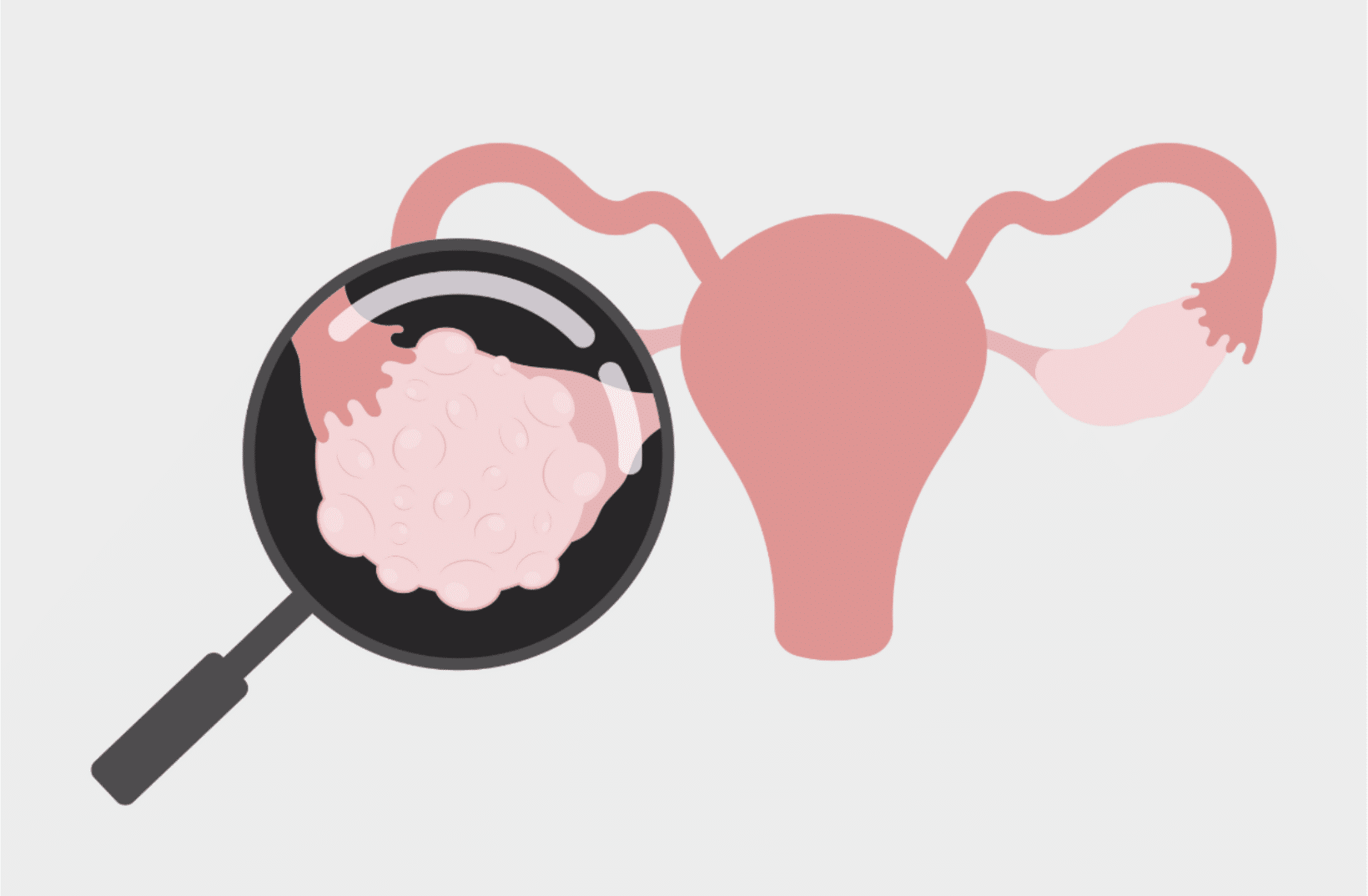
An ovarian cyst is a fluid-filled sac that forms on or inside one of your ovaries, the two small organs on either side of your uterus that release an egg each month.
Cysts are extremely common, especially in the years before menopause. Many women have one at some point without ever knowing it. In fact, your ovaries make a small, temporary cyst-like structure almost every month as part of ovulation. Most of the time it disappears without anyone noticing.
The question that matters isn’t whether you have a cyst. It’s what kind of cyst it is, because that’s what decides whether it will go away by itself.
Benign ovarian cysts: the main types
Benign means not cancer, and that describes the vast majority of ovarian cysts. But “benign” covers several very different kinds of cyst. Some disappear in weeks, and others never go away on their own.
First, two words on your ultrasound report: “simple” and “complex”
These words describe what the cyst looks like on ultrasound, not what type it is. They’re often the first thing patients read, and “complex” in particular can sound alarming.
Simple cyst. A simple cyst has a thin, smooth wall and contains only clear fluid, like a small water balloon. Simple cysts are almost always benign, especially before menopause. Most are functional cysts (explained below) that go away on their own. Usually the plan is just a follow-up ultrasound to make sure it’s shrinking.
Complex cyst. A complex cyst is anything that isn’t purely clear fluid. It may have thicker walls, thin dividing walls inside (called septations), blood, debris, or solid-looking areas. “Complex” does not mean cancer. Many common benign cysts look complex on ultrasound, including hemorrhagic cysts, dermoid cysts and chocolate cysts. It does mean the cyst needs a careful look to identify exactly what it is, and sometimes a follow-up scan, bloodwork or surgery to be sure.
This is where the experience of the person doing the ultrasound matters most. Dr. Kim can usually tell which of the types below he’s looking at during your visit.
Functional cysts: the kind that usually go away
Cleveland Clinic notes that functional cysts are the most common kind. They form as a normal part of your menstrual cycle and usually shrink on their own within one to three cycles.
Follicular cyst. Each month, an egg grows inside a small sac called a follicle. Normally the follicle breaks open to release the egg. If it doesn’t, it can keep filling with fluid and become a cyst. On ultrasound, it usually looks like a simple cyst.
Corpus luteum cyst. After the egg is released, the empty follicle turns into a structure called the corpus luteum, which makes the hormone progesterone to support a possible pregnancy. Sometimes it fills with fluid or a little blood instead of shrinking. Corpus luteum cysts are especially common in early pregnancy, when the corpus luteum supports the pregnancy until the placenta takes over. It usually shrinks on its own by the second trimester.
Hemorrhagic cyst. This is a functional cyst, usually a corpus luteum cyst, that has bled inside. On ultrasound it often has a lacy or web-like pattern, so it’s read as “complex.” It can be quite painful, but it usually resolves on its own within a few cycles.
Benign cysts that don’t go away on their own
These are less common, and they’re the ones that sometimes need surgery.
Dermoid cyst (also called a mature teratoma). Dermoid cysts grow from the type of cells that can make many different tissues, so they can contain hair, fat, skin, or even teeth. They’re almost always benign. They don’t disappear, though, and they can slowly grow, which raises the risk of ovarian torsion (explained below). They’re common in women in their 20s and 30s.
Chocolate cyst (an endometrioma). A chocolate cyst forms when endometriosis, tissue similar to the uterine lining, grows on the ovary. Each month it bleeds a little into the cyst, and the old blood turns thick and dark brown, like melted chocolate. Chocolate cysts are often linked with painful periods, pain during sex and pelvic pain, and they can affect fertility. Read more in “It’s Just a Bad Period”: What Most People Get Wrong About Endometriosis and Fertility.
Cystadenoma. Cystadenomas grow from the surface of the ovary and fill with watery or mucus-like fluid. They’re usually benign but can grow very large.
What about PCOS?
Despite the name, polycystic ovary syndrome (PCOS) doesn’t mean your ovaries are full of true cysts. The “cysts” seen on ultrasound are many small follicles that didn’t release an egg. It’s a hormonal and metabolic condition, and it was renamed PMOS in 2026 partly to clear up exactly this confusion.
Can ovarian cysts be cancerous?
Rarely. The vast majority of ovarian cysts are benign, especially in women who haven’t gone through menopause. The risk rises after menopause, and certain features on ultrasound call for a closer look. That’s why the type and appearance of your cyst matter so much more than just knowing it’s there.
Family history of gynecologic cancer? Consider genetic testing
Most ovarian cysts have nothing to do with cancer. But your family history still matters for your long-term health. Some cancers run in families because of inherited changes in certain genes. The best-known examples are BRCA1 and BRCA2, linked to breast and ovarian cancer, and Lynch syndrome, linked to colon and endometrial (uterine) cancer.
If a close relative has had ovarian, uterine (endometrial), cervical or breast cancer, we recommend genetic testing. Knowing your risk early gives you and your doctor time to plan screening and prevention, instead of waiting for a problem to show up.
At Yunella, we offer the Natera Empower hereditary cancer test. It’s a simple blood or saliva sample, and results are usually back in about two weeks. Dr. Kim then goes over the results with you and explains what they mean for you and your family. Ask about it at your visit.
What does an ovarian cyst feel like?
Many cysts cause no symptoms at all and are only found on an ultrasound done for another reason. When they do cause symptoms, women often describe:
- A dull ache or pressure on one side of the lower belly
- Bloating or a feeling of fullness, even after eating very little
- Pain during sex, especially deep pain
- Painful or irregular periods
- Needing to pee more often, or pressure on the bladder or bowel, if the cyst is large
Where is ovarian cyst pain located?
Ovarian cyst pain is usually felt low in your belly, on one side, the same side as the ovary with the cyst. You have one ovary on your right and one on your left, so the pain is often described as “right-side” or “left-side” pelvic pain, just below and inside your hip bone.
The pain can also spread to:
- Your lower back, on the same side
- Your upper thigh
- Deep in your pelvis, especially during sex or a bowel movement
What does ovarian cyst pain feel like? Most women describe a dull ache, pressure or heaviness on one side, a bit like a bruise deep inside. It may come and go, feel worse around ovulation or your period, or flare up with exercise or sex.
Sudden, sharp, severe pain is different. It can mean a cyst has burst (ruptured) or twisted the ovary (torsion), and it needs care right away. See the emergency signs below.
Right-sided pain? Don’t assume it’s a cyst. Pain in the lower right belly can also come from appendicitis, which is an emergency. If your pain is getting worse, moves toward your belly button, or comes with fever or vomiting, get seen urgently.
Can an ovarian cyst cause back pain? Yes. A cyst can cause a dull ache in the lower back or thighs, usually on the same side as the cyst.
Can it cause weight gain? A cyst itself doesn’t make you gain fat. But a large cyst can make your belly look or feel bigger, and conditions linked to some cysts, like PCOS, are associated with weight changes. (If weight is part of what you’re dealing with, read our guide to GLP-1 medications.)
When it’s an emergency: rupture and torsion
Two complications need care right away.
A ruptured cyst means the cyst has burst. Many small ruptures cause a sudden sharp pain that fades over a day or two. But a rupture can also cause internal bleeding, which can make you feel weak, dizzy or faint.
What is ovarian torsion?
Ovarian torsion means your ovary has twisted around the tissue that holds it in place. Often the fallopian tube twists along with it. Think of it like a garden hose getting kinked: the twist squeezes the blood vessels that feed the ovary, so blood can’t flow in or out.
Without blood flow, the ovary starts to swell and can be damaged. That’s why torsion is a surgical emergency. The sooner it’s treated, the better the chance of saving the ovary.
Why cysts raise the risk. A healthy ovary is small and light. A cyst makes it bigger and heavier on one side, which makes it easier to flip over. According to StatPearls, a medical reference from the U.S. National Library of Medicine, an ovarian mass of 5 centimeters (about 2 inches) or larger is the main risk factor.
Who’s most at risk:
- Women with a larger ovarian cyst, including a dermoid cyst
- Pregnant women, whose ovaries are enlarged in early pregnancy
- Women going through fertility treatment, because medications that stimulate the ovaries make them larger. If you’re doing ovulation induction or IUI and develop sudden one-sided pain, call us right away.
- Torsion can also happen in teens and young girls, sometimes even with a normal-sized ovary
What torsion feels like. Usually it’s sudden, severe pain on one side of the lower belly or pelvis, often with nausea or vomiting. The pain can spread to your back or side. Sometimes the ovary twists and untwists on its own, so the pain comes and goes in waves before becoming constant. That on-and-off pattern is easy to dismiss, so don’t.
How it’s diagnosed. An ultrasound with Doppler, which shows blood flow, is the first test. But torsion can be hard to catch on imaging. Blood flow may look normal if the ovary has untwisted for the moment, or because the ovary has two blood supplies. A normal scan doesn’t fully rule it out. If symptoms strongly suggest torsion, the only way to know for sure is to look directly during surgery.
How it’s treated. Torsion is treated with laparoscopic surgery (through small incisions with a camera) to untwist the ovary, called detorsion. Any cyst causing the problem is usually removed at the same time.
Here’s the encouraging part. Even an ovary that looks dark and swollen during surgery can often recover once blood flow returns. StatPearls reports that after detorsion, the ovary works normally again in more than 90% of patients. So for women of childbearing age, the goal is almost always to save the ovary, not remove it. Removing the ovary is reserved for rare cases: an ovary that’s beyond saving, a suspected cancer, or after menopause.
The best protection is catching a risky cyst early. If you know you have a cyst 5 cm or larger, or a dermoid cyst, talk with your doctor about whether removing it now, as a planned procedure, makes more sense than waiting for an emergency.
Go to the ER or call 911 if you have:
- Sudden, severe pain in your lower belly or pelvis
- Pain with fever or vomiting
- Dizziness, fainting, or feeling like you might pass out
- Cold, clammy skin or fast breathing
If you could be pregnant and have one-sided pain, get seen urgently too. An ectopic pregnancy can cause the same kind of pain.
How ovarian cysts are diagnosed at Yunella
The most important tool is a pelvic ultrasound, and at Yunella it’s done in our office by Dr. Kim himself, not by a technician whose images are read later by someone you never meet.
That matters more than it sounds. Dr. Kim has nearly 30 years of experience in gynecology and minimally invasive surgery. When he looks at a cyst, he’s looking at it as the surgeon who would remove it if it ever needed to come out. He checks:
- Size. How big the cyst is, in centimeters.
- What’s inside. Whether it’s simple fluid, blood, or something more complex.
- The walls and structure. Smooth and thin, or thick, with solid areas or dividing walls (called septations).
- Blood flow. Using Doppler ultrasound to see whether blood is flowing to any solid parts.
Those features usually tell him what type of cyst it is during the same visit. You see the screen with him and hear what it means right away, instead of waiting days for a report. The same scan also checks your uterus for other common causes of pain and bleeding, like fibroids and polyps. (Learn more about ultrasound at Yunella.)
Other tests you might need:
- A pregnancy test, to rule out pregnancy, including an ectopic pregnancy.
- Bloodwork, in some cases. For example, a tumor marker called CA-125 may be checked when a cyst looks complex or after menopause. CA-125 can also rise for harmless reasons like endometriosis or your period, so it’s used alongside the ultrasound, not on its own. Blood draws are done at the lab in the building next door.
- A follow-up ultrasound a few weeks later, often timed to a different point in your cycle. If a cyst has shrunk or disappeared, it was almost certainly functional.
Watch it or remove it? How the decision is made
Finding a cyst on an ultrasound is not, by itself, a reason for surgery. The decision depends on four things: what type it is, how big it is, whether it’s causing symptoms, and whether it goes away.
When watching and waiting is the right call
Most cysts fall into this group, especially simple, fluid-filled cysts in women who haven’t gone through menopause. You may simply have a repeat ultrasound in a few weeks to confirm it’s shrinking. In the meantime, over-the-counter pain relief and a heating pad can help with discomfort.
Does birth control get rid of cysts? Hormonal birth control stops ovulation, which can prevent new functional cysts from forming. It doesn’t shrink a cyst you already have.
Can you shrink an ovarian cyst naturally? Functional cysts usually shrink on their own with time. No diet, supplement or tea has been shown to dissolve a cyst, and the types that don’t go away by themselves won’t respond to home remedies.
What size of ovarian cyst is dangerous?
There’s no single number that makes a cyst dangerous. A small cyst with worrying features can matter more than a large simple one. That said, size does play a role:
- Larger cysts are more likely to rupture or cause torsion, because they make the ovary heavier.
- Very large cysts are often removed. Cleveland Clinic notes that doctors may recommend removing a cyst larger than 10 centimeters (about 4 inches).
- A cyst that keeps growing on follow-up scans needs a closer look, whatever its size.
When surgery is usually recommended
Dr. Kim is likely to recommend removing a cyst when:
- It doesn’t go away after a few menstrual cycles
- It’s a type that won’t resolve on its own, like a dermoid cyst, cystadenoma, or some endometriomas
- It’s large or growing
- It’s causing pain or other symptoms that affect your life
- It has features on ultrasound that need a definite answer
- You’ve had torsion or a rupture with bleeding
- It may be affecting your ability to get pregnant
What surgery involves
The usual operation is a laparoscopic ovarian cystectomy. Laparoscopic means it’s done through a few small incisions using a thin camera, instead of one large cut. Cystectomy means removing just the cyst.
The goal is to remove the cyst and keep your ovary whenever possible, so your hormones and fertility are protected. The cyst is sent to a lab (pathology) so you have a definite diagnosis.
Dr. Kim performs the surgery himself at Cedars-Sinai Medical Center. He received the AAGL Outstanding Laparoscopist Award and served on Cedars-Sinai’s Center of Excellence for Minimally Invasive Gynecologic Surgery. That means the doctor who scanned your cyst in the office is the same doctor in the operating room. You never start over with a surgeon who has never met you.
Recovery: Most patients are up and moving the same day and go home the same day. Many return to desk work within one to two weeks, with heavier activity a little later. Learn more on our gynecologic surgery page.
Can an ovarian cyst cause infertility?
Most cysts don’t. Functional cysts come and go with your cycle and don’t affect your ability to get pregnant. Dermoid cysts and cystadenomas usually don’t either, though a large one may need to be removed before you try.
The main exception is endometriomas. Endometriosis can affect fertility in several ways, and endometriomas can lower your ovarian reserve, the number of eggs you have left. Surgery on the ovary can also affect that reserve. So if you hope to get pregnant, how and whether to operate is a careful decision, made with your fertility plans in mind from the start.
Another cause of “cysts” and trouble conceiving is PCOS, where irregular ovulation, not the follicles themselves, is the real issue. At Yunella, Dr. Kim treats this in-house with ovulation induction using letrozole.
If you’ve been trying for a while, a fertility evaluation usually includes an ultrasound and a full hormone panel, which can also check your ovarian reserve. It may also include a check that your fallopian tubes are open (see HyFoSy vs. HSG) and a look for uterine polyps, another common and very treatable cause of trouble conceiving.
Ovarian cysts in pregnancy
It’s common to see a small cyst on an early pregnancy ultrasound. Usually it’s the corpus luteum, the structure that makes hormones to support the pregnancy until the placenta takes over. It typically shrinks on its own by the second trimester.
Because Dr. Kim does an ultrasound at every prenatal visit, any cyst found in pregnancy is followed closely, visit by visit. (Read more: How Many Ultrasounds Do You Get in Pregnancy?)
The bottom line
Most ovarian cysts are a normal part of your cycle and go away on their own. Some don’t, and those usually need a closer look and sometimes surgery. What matters is knowing which kind you have, and that comes down to a careful ultrasound read by someone who knows what to look for.
If you’ve been told you have a cyst, or you’re dealing with pelvic pain that hasn’t been explained, you don’t have to wait and wonder. At Yunella, Dr. Kim will scan you himself, explain exactly what he sees, and walk you through your options, whether that’s a follow-up scan or a plan for surgery. Partners or anyone you’d like to bring are always welcome.
Don’t just take our word for it: read our patient reviews. Then book a consultation or call us at (424) 404-8832. Already been told you need surgery somewhere else? A second opinion is a reasonable thing to ask for.
Medically reviewed by David Seil Kim, MD, PhD, MBA, FACOG · Last reviewed: October 22nd, 2026